top of page

All Posts


At 21, I divided a 24”x 32” paper into 48 4” squares and set rules to create designs that included squares, triangles, and circles that could be any size, color, value, and texture. I was amazed and discovered that there could be a seemingly endless number of combinations. I had an epiphany of a universe that is boundless, infinite, and timeless. This led me to non-objective paintings, and I chose to study under a professor who created beautiful color-field paintings. At the end of my undergraduate studies, I exhibited 10 of these paintings at the University of Hawaii Campus Center Gallery with my friend. My paintings were not impressive, but it was a start for my career as an artist.

In the early 20th century, science prompted a universal visual language based on the rejection of Renaissance artistic representation...the mandate to reorganize, simplify, and abstract what we experience and see to create new styles of painting. Cubism sought a universal structure. Futurism sought a universal energy. Constructivism sought a universal order. By contrast, Kandinsky sought a universal soul.

In Concerning the Spiritual in Art, he wrote, “Color is a power that directly influences the soul.” ...inspired by Goethe’s emotional perception of color. He also wrote, “The artist is the hand that, by touching this or that key, sets the soul vibrating automatically.” He compared the elements and principles of art to the melody, rhythm, and structure of music, as well as to universal spiritual beliefs that transcend religious boundaries. “The deeper the blue becomes, the more strongly it calls man toward the infinite.” Piet Mondrian and Kasimir Malevich began their artistic careers experimenting in Cubism but arriving at a similar destination: that the essence of art is spiritual, not based on a reproduction of the material world. Two world wars led to mass confusion and doubt about the future of mankind. In despair, a new generation of Abstract Expressionism arose in the 1940s, not based on spiritual hope but on its denial.


In the early 20th century, a growing belief emerged among the avant-garde for a need for a universal visual language that encompassed all cultures—east, west, north, and south. They felt that traditional art and culture were outdated. Dual approaches were developed. One was based on the promise of science, the other on a dive into spirituality.

The invention of vaccines, electricity, cars, airplanes, and movies at the start of the 20th century stunned the world. All were made possible by scientific discovery. Darwin’s theory of evolution and Einstein’s theory of relativity opened up a new universe in what was possible. Artists began to view their role as leading our culture into the future in this new reality. Darwin destabilized fixed creation. Einstein overturned Newton’s universe, where space and time had once seemed fixed and eternal. Cézanne cracked the foundation of Renaissance space, while Picasso, Braque, and Gris shattered it completely. Though these artists and scientists traveled separate paths, they shared the same awakening: reality was no longer stable, singular, or absolute. The modern world had entered an age of fractured perception.

At 21, I began to deconstruct the surface of a painting into geometric forms, painting its tables, windows, wine bottles flat, shaded, upside down, sideways, and from above. Cubism was a visual deconstruction based upon scientific analysis and a synthesis of information. In Italy, artists such as Severini, Boccioni, Russolo, and other Futurists projected a fractured spatial reality based on a worship of machines, cars, factories, and so forth, providing evidence of our evolution. During the Russian Revolution in 1917, Constructivist artists created a style in defiance of the realism of aristocratic rulers. Lenin and Trotsky adapted it; Stalin rejected it and then filled the streets with nationalistic posters of the working class.

In my opinion, this form of a universal visual language fell short. Brilliant, but too cool, too cerebral. Not the type of future I would want to live in.


Most people spend their lives hiding their deepest emotions behind social rituals, masks, and daily responsibilities. Yet artists throughout history have done the opposite. They reveal what others conceal. When I was young, I believed painting was about learning technique. Later, I realized technique was only the language, and the real question was, what inner necessity compels a person to paint at all?

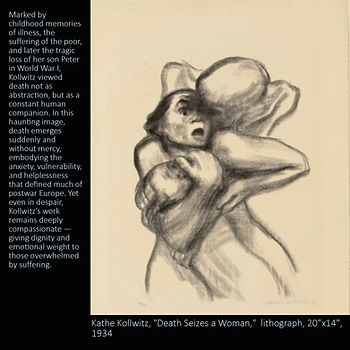
“My real and deepest motives for making art go back to the experience of my own sorrow… I want to have an effect on this time in which human beings live so difficultly and need all the help they can get.” -- Kathe Kollwitz. Her younger son died after he volunteered in WW1 to fight for the German army. She started as a patriot but saw the horror of war sweeping over her nation and witnessed many people she knew who were killed either in battle or in the Holocaust.

“Art is the blood of our heart.” --Edvard Munch. His mother died of tuberculosis when he was just 5 years old, soon followed by his sister, Sophie. He transformed his early trauma into paintings that impact those who see them. They were authentic.

The existential suffering of Kollwitz, Munch, and others defined avant-garde Expressionism of the early 20th century, which also arose from an emerging visual language informed by science and global awakening. It started as a form of catharsis, a way to heal, but morphed into the dark paintings from Germany and Austria and into the growing horror movie genre in films like “Nosferatu.” The audience gasped in shock from the violence and delighted in the monstrosity depicted. From the 1970s onward, it reincarnated into Neo-Expressionism. Their paintings caught the attention of art critics, who celebrated their creativity…their daring, bold, dark, and violent images. Their works were based on a worldview different from the Expressionists of the early 20th century…the dark twin fascinated, not horrified, by the dark side of human nature. Which side will you stand on as an artist?


Contact Kenneth Nakamura

Honolulu, Hawaii

artlookingforhome@gmail.com

Affordable Original Paintings

©2022 by Art Looking for a Home. Proudly created with Wix.com

bottom of page